













Charging is one of the biggest concerns for electric vehicle owners and potential buyers. The different types of EV chargers, connectors and their abbreviations can start to sound like alphabet soup, so here’s what you need to know to help make sense of it all.
EV Charging Levels
There are three levels of EV charging, each offering different speeds and best-use cases. John Higham, vice president of media relations for the Electric Vehicle Association, and Joel Levin, executive director of Plug In America, a not-for-profit EV advocacy group, contributed insights on each option.
More detailed information about EV charger types is available from the U.S. Department of Energy.
Level 1
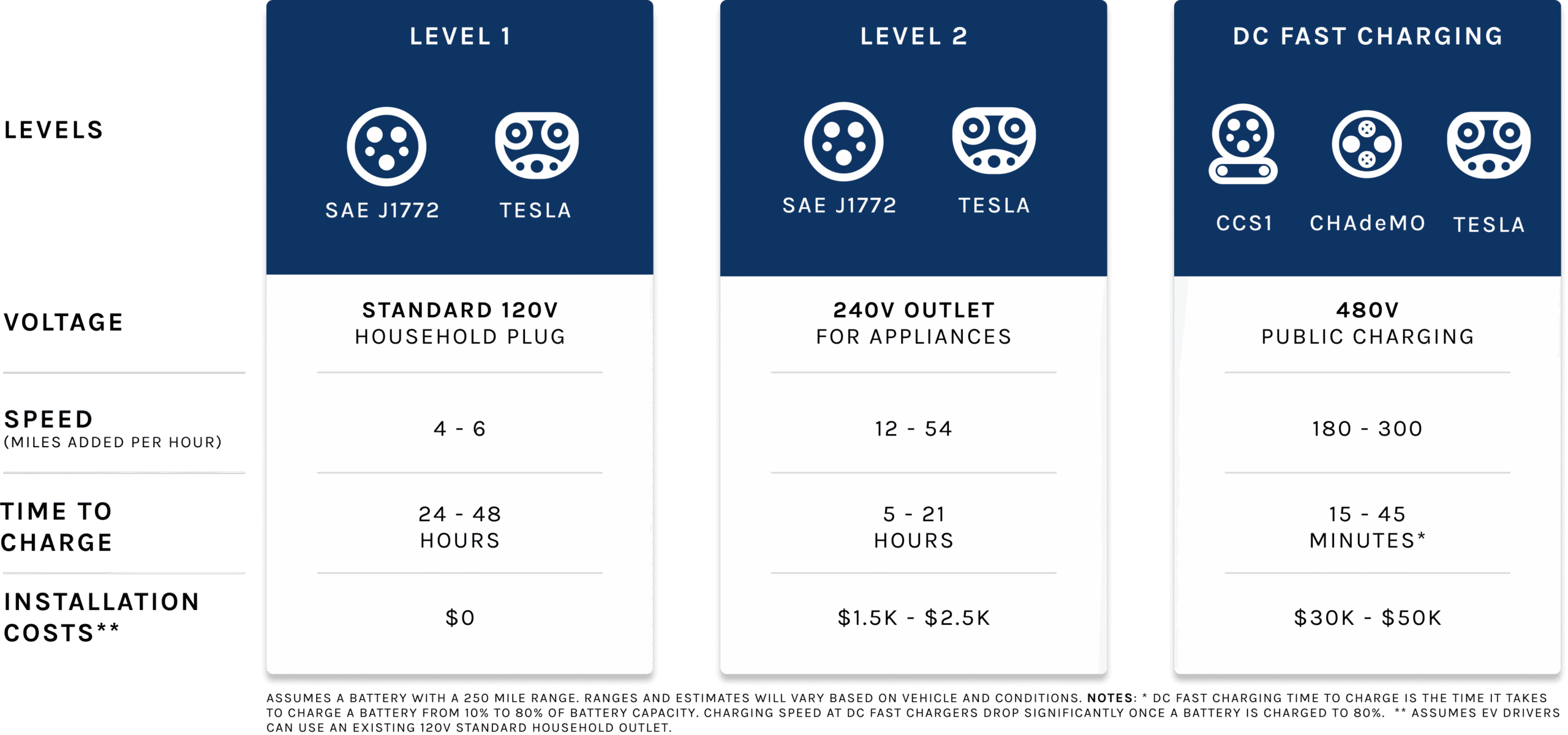
Level 1 charging uses a standard 120-volt household outlet. There is no special equipment or installation required, but it’s slow.
“Expect it to take an hour to charge the equivalent of 3 miles of range. This will take a weekend, or longer, to completely charge most EVs,” Higham said.
EV drivers who don’t put too many miles on their car can usually rely on their home outlet for regular charging needs.
“If your daily commute is fewer than 40 miles, start with Level 1,” suggested Levon.
When charging on a home outlet, you want to be sure that you can connect your EV without an extension cord, which can potentially overheat and start a fire.
Level 2
Level 2 uses 240 volts, the same as a dryer or oven. Level 2 chargers are often offered at public places and at businesses but can also be installed at home for faster charging. Plug-in hybrids also use Level 1 and Level 2 charging.
“This is the most practical for home use and can add up to 40 or so miles of range every hour,” Higham said. “This is what you want to charge your EV overnight.”
If you decide to install a home charger, first review your home electrical panel to determine whether it has enough capacity for a charger or if you need to upgrade.
“Many drivers don’t need the highest-power charger available,” said Higham. “This is important if your electrical panel is already close to capacity. Many EVs today will charge at 60 or 80 amps on Level 2.”
You should also hire a licensed electrician who specializes in EV charger installations.
“Home EV chargers are high-powered electrical devices, such as an oven or welder,” Higham said. “But unlike the oven or welder, an EV charger will remain at high power for hours and hours, day in and day out.”
DC Fast Charging (DCFC)
This is the public infrastructure charging option installed by various fast-charging networks at shopping centers and freeway off-ramps.These devices can add 200 miles of range in just a few minutes, depending on the type of car, according to Higham. On a mile-for-mile basis, they can also cost as much or more than gasoline
Understanding EV Connectors
Each of the three levels of charging are compatible with one of four types of connectors in use in North America. Depending on your EV and the charger you’re trying to use, you might need an adapter.
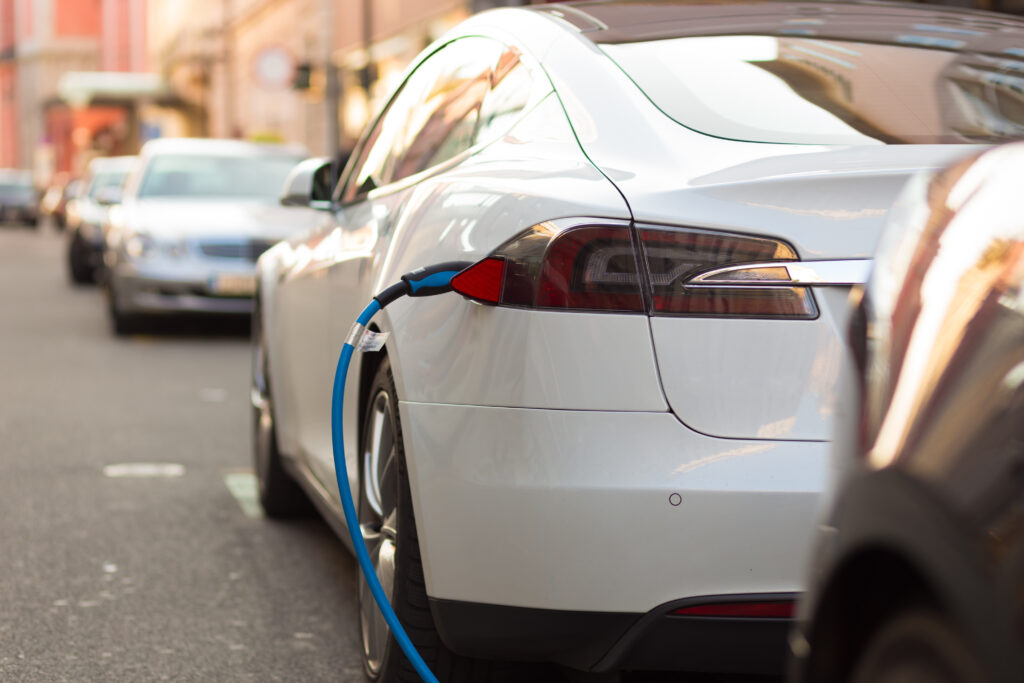
Most DC fast‑charging stations include built‑in cables, but many Level 2 public chargers do not, so you may want to carry your own. Since not all EVs come with a Level 2 home‑charging cable, you may need to purchase one separately.
J1772
Standardized by the Society of Automotive Engineers (SAE), the J1772 connector is compatible with Level 1 and Level 2 chargers.
CHAdeMO
CHAdeMo is a DC fast charger that is slowly being phased out in the U.S. The only new car still equipped with a CHAdeMO port is the Mitsubishi Outlander PHEV, and you will also find it on used Nissan LEAF models through.The existing charging stations are likely to remain operational for at least another decade.
CCS (also called CCS1)
Most EV models on the market can be charged using a CCS connector. The same charge port works with AC Level 1, Level 2 and DCFC equipment. You can spot this fast-charging connector because it has two additional bottom pins.
NACS/Tesla/J3400
The North American Charging Standard (NACS) also known as the J3400 plug or Tesla plug was standardized by the SAE in 2024 and is compatible with all charging levels, including DCFC and Tesla Superchargers. Tesla vehicles can use adapters to use CCS or CHAdeMO chargers. NACS ports are becoming standard on many EV manufacturers’ cars.
“The two types of connectors for DCFC, CCS and NACS, are both going to be with us for a long time,” Higham said. “If you think you’ll use DCFC a lot, you’ll want an adapter, regardless of the type of car you have, because you’ll want to maximize your options when it comes to charging in public.”
While the North American market is rapidly pivoting to the NACS connector, there are so many J1772/CCS cars out there that drivers must be prepared.
“Any EV road warrior will be traveling with appropriate adapters for at least the next decade,” Higham said.
Whether you’re plugging in at home or stopping at a high-speed DC fast charging station, EV drivers today have more charging options than ever before. Knowing the differences between charging levels and connector types helps ensure you’re ready to power up wherever the road leads.
AAA’s Recommendation: Whether you own an electric vehicle or a gas-powered car is up to you – and you should consider lots of factors in making that choice. No matter what type of vehicle you’re choosing, we recommend visiting a dealership, test driving one, and asking as many questions as possible to make an informed decision.